
Next aircraft
| Typenumber | D.7. |
Type of aircraft |
Fighter |
| Country | Germany |
| Date first flight | 1918 |
| crew | 1 |
| Wingspan in metres | 8,9 m |
| Lenght | 7,0 m |
| Enginetype | Mercedes D-III |
| Engine power |
168 HP |
| Max speed | 189 km/h |
| Climb rate | 4.0 m/s |
| Max speed | 188 km/h |
| Ceiling | 7000 m |
| Range | 1h 30min |
| Armament | 2x7.9 mm Spandau 08/15 machine guns |
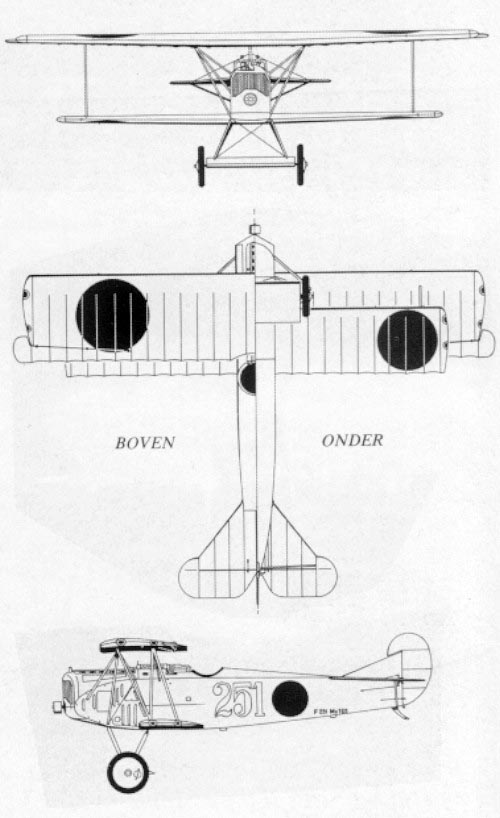
1918 werd de Fokker Dr.1 opgevolgd door de D.7. Deze tweedekker was uitgerust met een Mercedes motor, later werd deze vervangen door een BMW motor die het toestel nog 15 km per uur sneller maakte.
De vliegeigenschappen waren superieur aan de toestellen zowel die aan Duitse - als aan geallieerde zijde. Fokker bouwde niet zelf alle jagers, andere fabrieken vervaardigde D.7. in licentie.
In totaal werden er rond de 3000 toestellen gebouwd. Het toestel was zo succesvol dat aan het einde van de 1e wereldoorlog de geallieerden de Duitse D.7.'s opeisten als oorlogsbuit.
Fokker slaagde er in nog niet geleverde toestellen en half afgebouwde jagers naar Nederland te brengen per trein en per schip.

In Nederland werden nog ongeveer 100 toestellen gebouwd voor de Nederlandse en andere Europese luchtmachten.
Tot 1938 heeft de D.7. dienst gedaan bij de Nederlandse Luchtmacht.
| Fokker D.7 |
|---|



| Named in the Versailles Armistice |
|---|
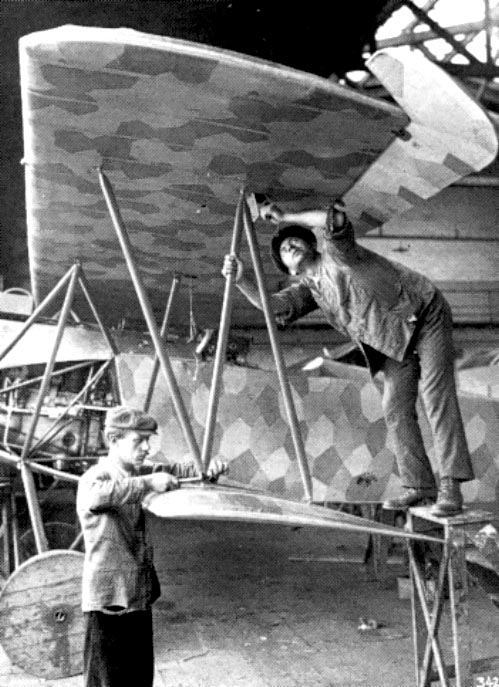
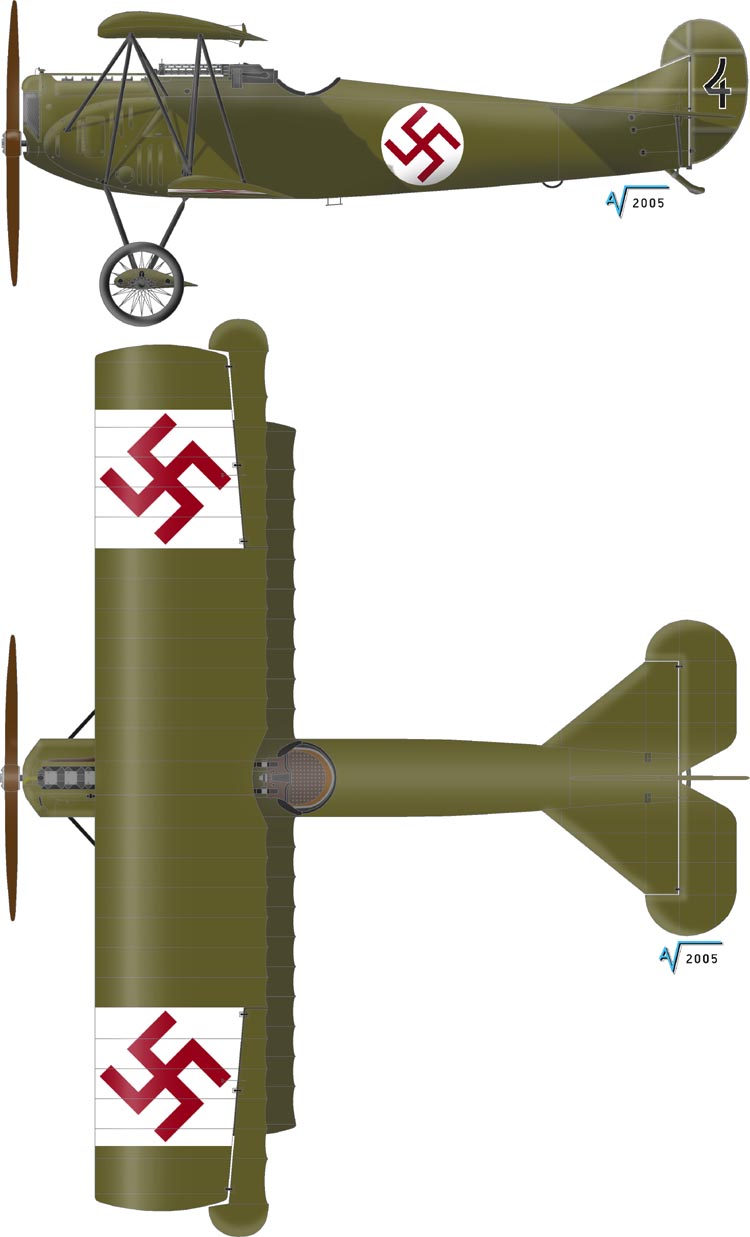
In 1917 Fokker and Reinhold Platz began work on a new aircraft. Platz was also the designer of the Fokker Dr.1. triplane fighter. The D.7. had a fuselage of welded steel tubing covered with aluminum and fabric. Thick-section wood wings were covered with plywood and fabric. The D.7. prototype demonstrated the necessity of a longer fuselage and fixed vertical fin in addition to the comma-shaped moving rudder.
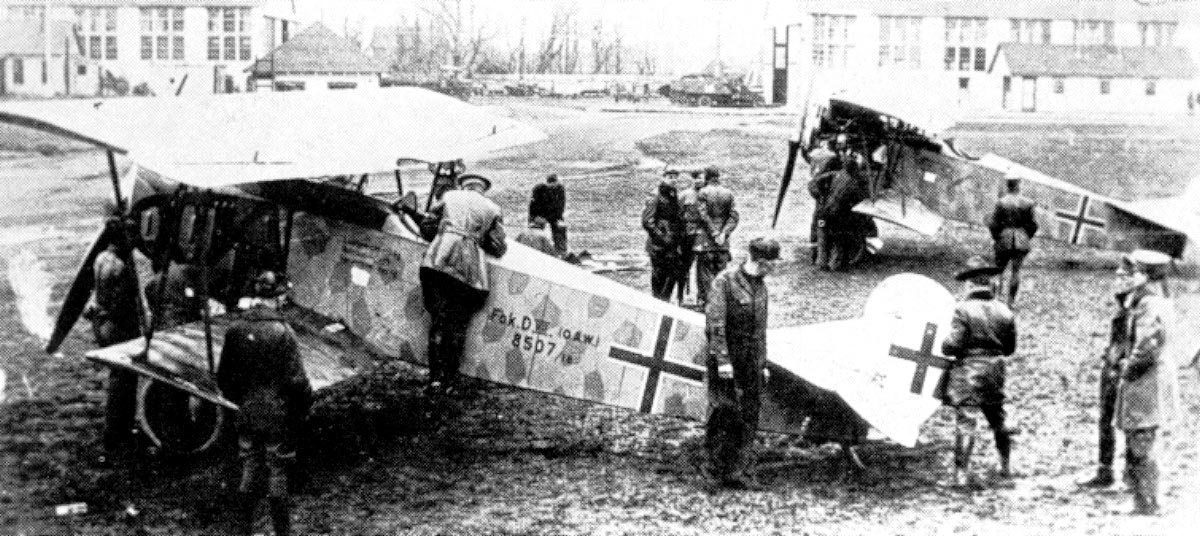
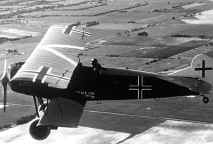
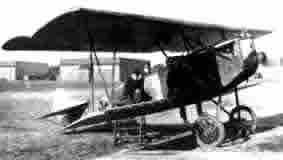
Work started late in 1917 to meet a specification calling for a D-type fighter powered by a 160 hp Mercedes D.III in-line engine with an auto-type radiator, the first in a German fighter. The D.7. entered the German War Ministry's competition at Johannistal Airfield, in Adlershof, in January and February of 1918, outclassing all 30 of the other participants. Among the evaluators was Manfred von Richthofen, who was particularly impressed by the 7's performance. Orders were placed for 400 from Fokker and a large number from Albatross and OAW. Of the 2,000 ordered only 1,000 were built before the war's end. The D.7. entered combat in April 1918 at the second battle of the Aisne with the first consignment going to Jagdgeschwader I (Fighter Wing One) commanded by von Richtofen. One month before the Armistice, 800 D.7.'s were in service at the front. There were still some 700 in service at the time of the Armistice, the terms of which acknowledged the superiority of the D.7. as a combat aircraft, with the treaty of Versailles specifically singling out this airplane for surrender to the allies. The Fokker D.7. was strong, fast and superb at high altitudes and was extremely popular with the German pilots. The Fokker D.7. became the platform for a number of German aces, including Herman Goering, who was later to become the Reichmarshal of the Luftwaffe in World War II. Although von Richtofen evaluated the D.7. he achieved his aerial victories while flying the Albatross D.IIIs and Dr.1. triplanes (painted generally red, hence "Red Baron"). Later in 1918 a more powerful BMW D.IIIa engine of 185 hp was installed in the D.7., increasing its rate of climb and raising its ceiling to almost 20,000 feet. Among the exceptional qualities of the airplane, apart from speed, maneuverability and rate of climb, were ruggedness and outstanding performance at high altitude. The D.7. was easy to fly, yet responsive to the controls right up to it ceiling. The F, and final, version appeared in August, 1918. |
|
|








| Fokker D.7 in the U.S. |
|---|
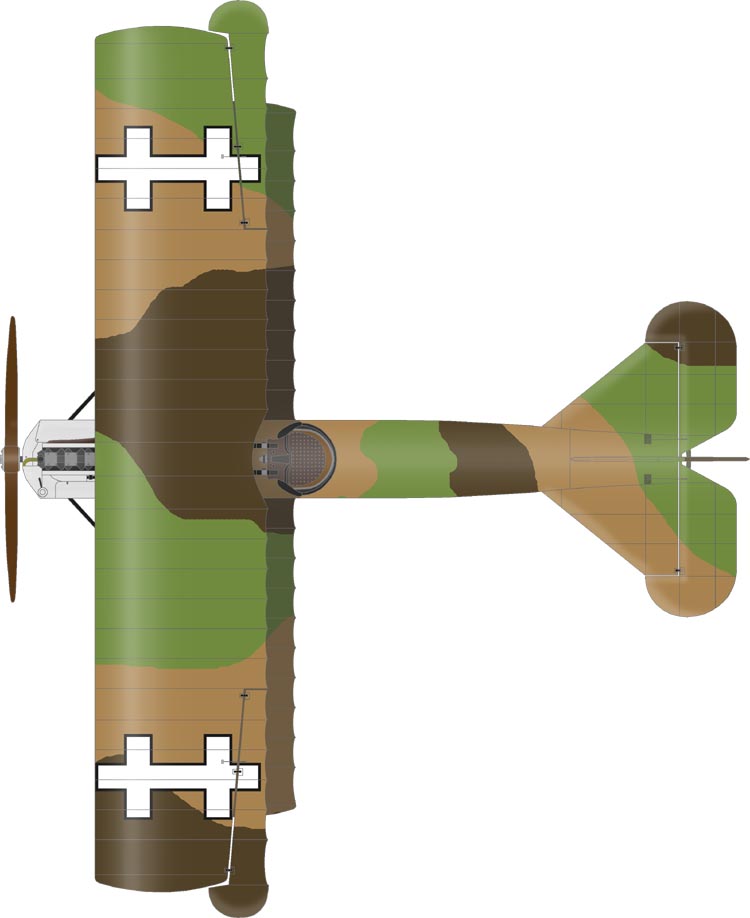
Of 142 Fokker D.7's brought into the United States by the Army Air Service after the Armistice to be used as trainers, six were transferred to the Navy and used as trainers at Quantico, Virginia, by the Marine Corps until 1924. U.S. Naval aircraft design was influenced by the D.7., the Boeing FB-1 fighter of 1925 being the first of several Naval aircraft to feel the D.7.'s subsequent influence. The Navy had previously ordered (on 1 May 1920) twelve D.VIIs from the Army for developmental work in metal construction. The Fokker D.7. is the only aircraft mentioned in the Armistice demands of November, 1918. Germany was ordered to surrender "1,700 fighting and bombing aeroplanes-in the first place, all D7's and all night bombing aeroplanes". After all, not all D.7.'s were handed over. Some were flown back to Germany by their pilots and hidden in sheds. From the ones that were flown to the collection points of |
|
the Inter-Allied Control Commission, some were wrecked during landings or taxiing. After the war, some were sold abroad. After the first World War, Anthony Fokker returned to his native Netherlands and resumed limited production of his D.7., having successfully smuggled several copies, 400 engines and the dismantled parts of 120 aircraft from the Fokker Flugzeug-Werke company out of Germany as a starter stock for his new enterprise. In the 1920s the Fokker D.7. became the mainstay of the Dutch air force. |

